

As a plan sponsor, one of your primary duties is to ensure your plan data is organized. The start of each year presents a perfect opportunity to conduct an organizational review!
Why is this important? First, unorganized data leads to compliance issues – especially when it comes to meeting ERISA recordkeeping and IRS requirements. But aside from that, staying organized demonstrates diligent fiduciary oversight and streamlines plan administration and audits. In other words, proper organization helps avoid costly penalties, legal liabilities, and operational errors that can result from missing or inaccurate documentation tied to 401(k) record retention.
Fortunately, the systems we recommend below to help you stay organized are not complex. These rather simple systems are categorized with just a few file types – and they do the trick! Readily accessible plan documentation and well-organized records lead to smoother day-to-day operations and ease when it comes to managing risks.
So let’s take a look at how a properly organized plan would be laid out.
List of Recommended Folders for 401(k) Record Retention
Start with a primary folder called “401(k) Plan” or the full name of your Plan (ABC Company 401(k) Plan). This structure lays the foundation for consistent 401(k) record retention and easier document retrieval.
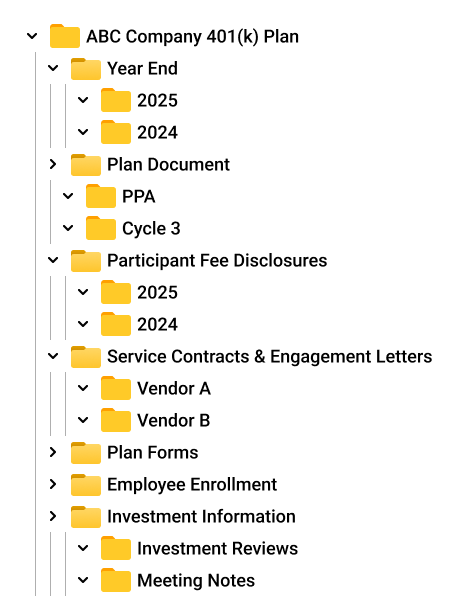
Create subfolders based on categories, such as:
Year End Folder
In this folder, you would save:
- The annual valuation report
- Form 5500
- The files and information you provided, such as the completed annual questionnaire and census.
Create a subfolder for each year.
Plan Document
In this folder, you would save all copies of:
- Plan documents
- Amendments
- Notices
- Summary Plan Description (SPD)
Create a subfolder for each plan document (PPA, Cycle 3, etc.)
Participant Fee Disclosures
In this folder, you would keep copies of:
- The required disclosure notices for each year
- A note of when each of these was distributed
Create a subfolder for each year.
Service Contracts/Engagement Letters
In this folder, you would keep:
- Copies of the contracts made with all service providers that assist/assisted with your plan.
You may consider creating subfolders for each service provider
Plan Forms
In this folder, you would keep copies of forms you’ll need to provide to employees, such as:
- Enrollment forms
- Beneficiary forms
- Distribution forms, etc.
- Qualified Domestic Relations Orders
As a note, some recordkeepers do not accept hard copies. However, others that offer hardcopy forms update these forms often. Always be sure to check that you have the most recent version of a form saved in your folder before providing it to a participant.
Employee Enrollment
In this folder, you would keep copies of:
- Notes on eligibility
- Completed election forms
- General notes, etc.
Investment Information
In this folder, you would keep copies of:
- Investment reviews
- Meeting notes
- Fund changes
- Fiduciary meeting notes, etc.
Other Suggestions
In addition to the documents and records saved in each category, keep notes on:
- Who provides that information
- Where any staff member can find this information (think like a Table of Contents of user guide to your folder).
- How would a new team member find what they were looking for if you won the lottery and left your company?
- Consider naming this file “START HERE – How to use this folder” or something similar
- Important website URLs
- Where to find forms, etc
- Keep a cheat sheet for onboarding new employees.
Check with your plan advisor for other suggestions and additional information.
Recommended List of 401(k) Plan Record Retention
Once your folder structure is in place, the next step is understanding what documents should be retained. The chart below outlines the core records plan sponsors should maintain to support compliance, fiduciary oversight, and smooth plan operations.
While 401(k) record retention and ERISA recordkeeping requirements can vary based on document type and regulatory guidance, this list serves as a practical reference to help ensure critical plan information is preserved, accessible, and audit-ready when needed.
The average retention period for these types of documents ranges from 5 to 8 years, but it’s dependent on the document. When in doubt, you can always review the rules the IRS has provided. Check the irs.gov website for specific guidelines.
Plan Document & Qualification
| Basic Plan Document (if using pre-approved) | All Signature Pages |
| Adoption Agreement (for pre-approved) | Amendments (discretionary or required) |
| Loan Policy | Summary of Material Modifications |
| Attorney Drafted Document | Participation Agreements |
| QDRO Policy | IRS Determination Letter or Opinion Letter |
| Summary Plan Description | Safe Harbor Notices |
| Trust Documents | Automatic Contribution Notices |
Plan Operation & Administration
| Payroll Records | Enrollment Forms/Elections |
| Contribution Remittance Records | Beneficiary Forms/Elections |
| Annual census file | Loan paperwork |
| Contribution election changes | Distribution paperwork |
| Recordkeeper reports & files | Participant Statements |
| Corporate minutes & resolutions | Policies & procedures |
| Service Agreements | Fee Schedules |
Annual Reporting & Tax Forms
| Annual Valuation Report/Testing | 5500 Form (signed and verification of filing) |
| Completed Questionnaire | Summary Annual Report |
| Copy of ERISA Fidelity Bond | Form 8955-SSA |
| Audit Records & Documentation | 1099’s/1096 |
| Late Deposits and corrections | Form 5330 |
Investments
| Fiduciary Meeting notes | Service Agreements |
| Investment review reports/notes | 408(b)(2) Plan Sponsor Fee Disclosures |
| Fund monitoring & changes | 404(a)(5) Participant Fee Disclosures |
| QDIA Notices | Blackout Notice |
Keep Your Plan Fresh
If you’re a plan sponsor for a defined contribution plan, the truth is you’ll be managing a lot of documentation. Not only is storing and keeping track of related documentation required by ERISA, but it’s also critical to your plan’s success!
Developing a filing system makes it easy for you to review, update, preserve, and dispose of documents quickly, so you can easily keep up with ERISA recordkeeping requirements. At Watkins Ross, we help our clients stay organized, compliant, and confident in how their plan documents are managed.
If you have any questions, give us a call at 616-456-9696 or send us a message online.